


Project Brief
New York City's Local Law 97 puts a hard carbon cap on large buildings and fines what goes over it. For most property types the response involves schedules and occupancy. Verizon's network buildings have neither: they run at high load 24 hours a day, and the switches and telecom equipment inside them cannot be turned down to save carbon. KeRi ran the energy and compliance program across five of these New York facilities.
The work covers both of the city's energy laws. Local Law 87 requires periodic energy audits and retro-commissioning on a set cycle, and Local Law 97 sets the emissions cap that the building has to come under. KeRi carried the audit and retro-commissioning work to satisfy LL87 while building the same evidence base the LL97 roadmap needed, so one exercise produced both the compliance filing and the capital plan.
Each building got an ASHRAE Level III investment grade audit: field survey, full equipment inventory, interviews with the building engineers, temperature and motor run-hour data loggers left on site, and BMS trend data pulled from the building. That fed an energy model in Carrier HAP, calibrated against historical utility bills, to produce a real end use breakdown rather than an assumed one. Retro-commissioning added functional testing of the HVAC equipment and the building management system. Baseline and projected carbon values were then established against each site's own cap, and every conservation and retro-commissioning measure was costed and payback tested individually before being sequenced into a roadmap.
The sites are 60 Hudson Street, one of the city's principal carrier hotels, 50 Thayer Street, 82-23 Broadway in Elmhurst, 1106 Hoe Avenue in the Bronx, and 204 Second Avenue. At Second Avenue the program went well past study: the failed steam absorption chiller was assessed for replacement with an electric machine worth roughly 725 tCO2e a year, and that work has its own page. Across the portfolio the roadmaps target a 40 percent cut in building carbon emissions by 2030 and 80 percent by 2050, with commissioning and measurement and verification confirming what the installed measures actually deliver.
MEP Engineering Scope
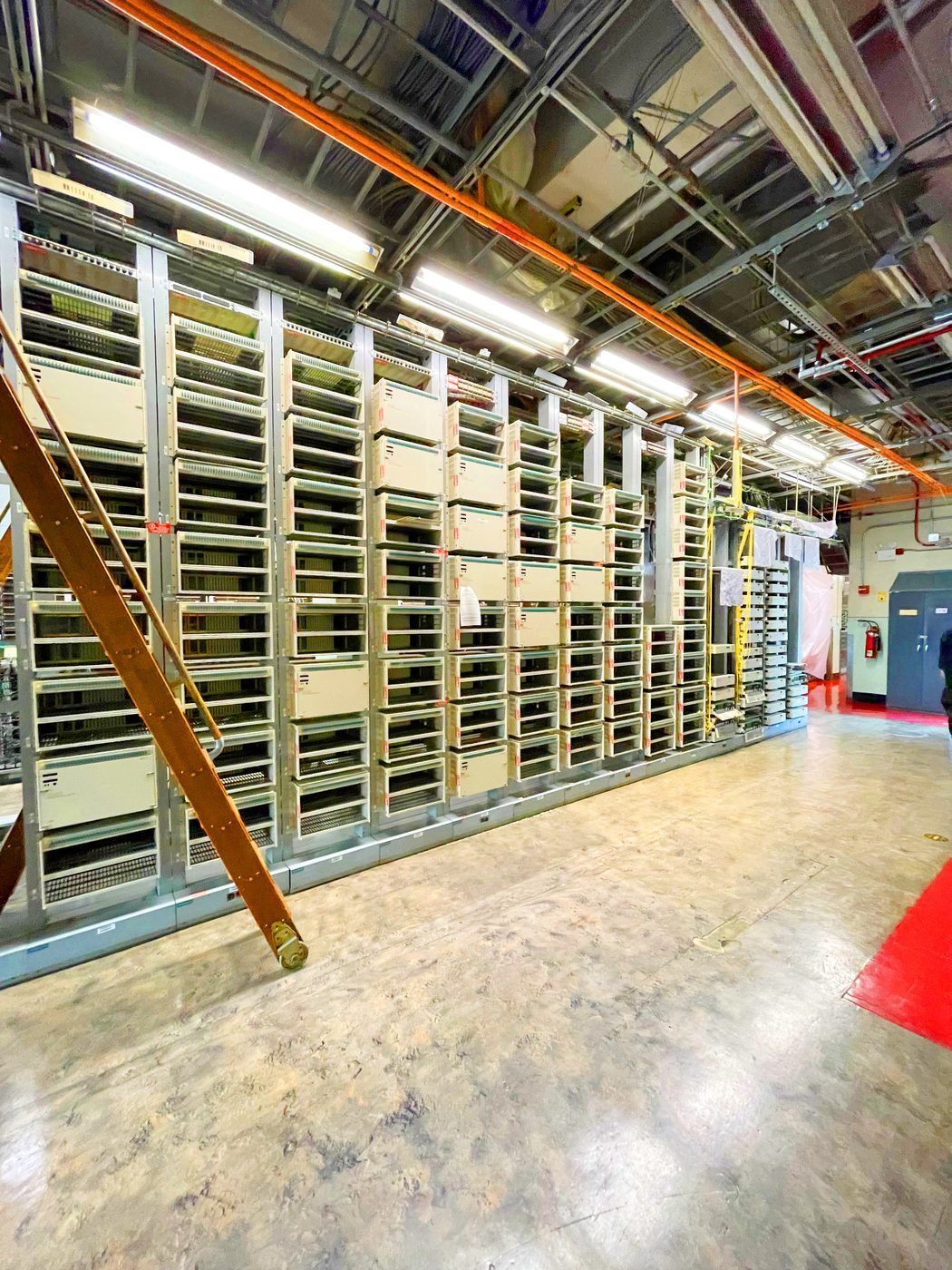
What We Engineered
Energy and carbon compliance across the New York network facilities:
- ASHRAE Level III investment grade energy audits at each facility
- Local Law 87 audit and retro-commissioning compliance
- Data loggers and BMS trend data behind every measure
- Calibrated energy models with per building end use breakdowns
- Baseline and projected carbon values against each Local Law 97 cap
- Commissioning and measurement and verification of what was installed
The Program
01What Local Law 97 Demands
- Local Law 97 sets a hard carbon cap per building type, with financial penalties for every ton over the limit, so the governing number for these buildings is tCO2e rather than energy cost
- The caps tighten across compliance periods, so a measure that clears today has to be judged against the next limit as well
- Network buildings are a difficult case: they run 24 hours a day at high load, and the equipment they cool cannot be switched off to save carbon
- That makes plant efficiency and fuel switching the levers that matter, not occupancy or schedule
02What Local Law 87 Demands
- Local Law 87 requires periodic energy audits and retro-commissioning, filed to the city on a set cycle
- KeRi carried the audit and retro-commissioning work to satisfy LL87 while building the same evidence base the LL97 roadmap needed
- Retro-commissioning included functional testing of the HVAC equipment and the building management system, not just a paper review
- Findings fed directly into the measure list, so compliance filing and capital planning came out of one exercise
03How Each Building Was Assessed
- ASHRAE Level III investment grade energy audits, with field survey, full equipment inventory, and interviews with the building engineers
- Temperature and motor run-hour data loggers installed, and BMS trend data pulled, so measures rest on observed operation rather than assumption
- Energy modelling in Carrier HAP, calibrated against historical utility bills, producing an end use breakdown per building
- Baseline and projected carbon values established for each site against its LL97 cap
- Every conservation and retro-commissioning measure costed and payback tested on its own, then sequenced into a roadmap
- Commissioning and measurement and verification to confirm what the installed measures actually delivered
04The Sites
- 60 Hudson Street, one of the city's principal carrier hotels
- 50 Thayer Street, Manhattan
- 82-23 Broadway, Elmhurst, Queens
- 1106 Hoe Avenue, the Bronx
- 204 Second Avenue, where the work went past study into a full chiller plant replacement worth roughly 725 tCO2e a year, covered on its own page
The Challenge
Local Law 97 caps carbon by building type and fines what exceeds it, but Verizon's New York network buildings offer none of the usual ways to comply. They run at high load every hour of the year, the equipment inside them cannot be scheduled down, and the buildings cannot be taken out of service to be worked on. On top of that, Local Law 87 requires audits and retro-commissioning on its own filing cycle, and the caps tighten with each compliance period.
Our Solution
KeRi built the LL87 audit and retro-commissioning work and the LL97 carbon roadmap as a single exercise, so the compliance filing and the capital plan came from the same evidence. Every site was audited to ASHRAE Level III with data loggers, BMS trends, and an energy model calibrated to real utility bills, with functional testing of the HVAC and the BMS, and each measure was costed and payback tested against the building's own carbon cap. Because schedule and occupancy were not available as levers, the measures target plant efficiency and fuel switching, which is what carried 204 Second Avenue into a full chiller plant replacement.
Previous Project Verizon District Steam PRV Next Project Verizon 204 Chiller Plant